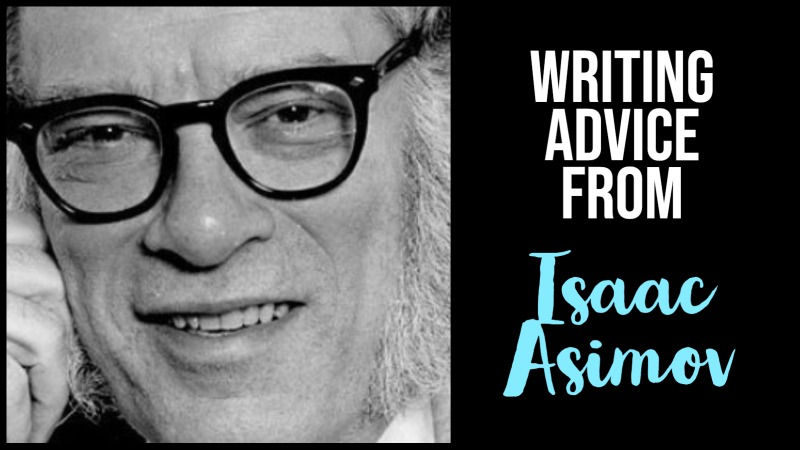
Isaac Asimov was born 2 January 1920 and died 6 April 1992. The American writer was born in Petrovichi, Russia. During his lifetime, Asimov, along with Robert A. Heinlein and Arthur C. Clarke, was considered one of the ‘Big Three’ science fiction writers.
His work often explored themes like the future with robotics, and the possible moral implications that face artificial intelligence. I, Robot is one of his most widely known written works.
He is one of the most prominent science fiction writers of our era. Asimov is to the genre what Tolkien is to fantasy: an influence that touches almost all subsequent work by other writers.
Asimov had a lifetime as a writer of books and short stories, but also essays and a vast letter collection. In total, Asimov has more than 500 books in his bibliography – and eventually, released special catalogues of his work to keep track.
His work, including the Three Laws Of Robotics and tales like I, Robot, have even inspired real-life research into robotics, morality, and user-safety.
How should a self-driving car react to a potential accident, for example? Asimov raised important questions like these through his work.
6 Bits Of Writing Advice From Isaac Asimov
1. Learn The Rules
‘Unfortunately, in many cases, people who write science fiction violate the laws of nature, not because they want to make a point, but because they don’t know what they are.’ – Conversations with Isaac Asimov
Fiction needs rules.
Science fiction relies on a mixture of what’s real, and what could be. Asimov points out that a writer must understand basic rules (like physics or gravity) before they are bent for a story.
A writer can’t just say an object defies gravity. The writer has to know something about gravity first.
Rules exist, especially in science fiction, such as what happens when a time traveller meets their past self.
2. Writers Influence
‘It is the writer who might catch the imagination of young people, and plant a seed that will flower and come to fruition.’– Past, Present and Future
All writers can influence the reader’s mind.
It’s a responsibility that every writer should remember. Words can enthral, inspire, enrage, or unhinge.
Markets ban overly violent fiction, for one example, because of the potential negative impact on readership. Books like Stephen King‘s Rage have been removed from circulation, by the author’s request, after it was found in the locker of an attacker.
Remember: words have impact, and use them with responsibility.
3. Writing Is Solitary
‘Writing is a lonely job. Even if a writer socializes regularly, when he gets down to the real business of his life, it is he and his typewriter or word processor. No one else is or can be involved in the matter.’– I, Asimov: A Memoir
Being a writer seems social, but isn’t.
Book releases make up less than 1% of what a writer does: elaborate dinner parties account for even less of the writer’s professional time.
A writer writes, and does so alone. A writer doesn’t call their publisher to watch them write.
Smartphones appeared in Star Trek decades before the popularity of modern devices. Asimov would write about the Laws Of Robotics long before artificial intelligence could hold a full conversation.
Asimov also speaks of human nature. Entire civilisations have come to an end due to lack of foresight, or eventual lack of resources.
Science fiction writers can benefit, greatly, from the study of anthropology and human nature. To know what we might do in future, it matters how humans have acted in the past.
5. Write To Be Clear
‘I made up my mind long ago to follow one cardinal rule in all my writing: to be clear. I have given up all thought of writing poetically or experimentally, or in any of the other modes that (if I were good enough) get me a Pulitzer prize.’ – Introduction To Nemesis
Plain language is what makes a best-seller that can be enjoyed by anyone who reads it.
One can’t expect to sell a million copies of a book that only 10% of that million would fully understand. That’s the essence of what Asimov meant with the above quote.
‘If my doctor told me I had only six minutes to live, I wouldn’t brood. I’d type a little faster.’ – Life Magazine, January 1984
Type, don’t brood.
Writers can do an awful amount of things that aren’t writing. Resist the compulsion to check social media, play games, or boil an egg when you should be writing.
Procrastination does not lead to great stories, or productive emails.
Asimov said it straight.
If you type, you’ll have something you can edit. But if you do everything else, you’ll look back on an empty few hours with no work done.
The Last Word
We hope these bits of writing advice from Isaac Asimov help you with your writing.
By Alex J. Coyne. Alex is a writer, proofreader, and regular card player. His features about cards, bridge, and card playing have appeared in Great Bridge Links, Gifts for Card Players, Bridge Canada Magazine, and Caribbean Compass. Get in touch at alexcoyneofficial.com.
And his writing is delightful. Every sentence in The Picture of Dorian Gray is quotable for better or worse.
His plays capture your attention with wonderful wordplay. And, his writing will leave you in despair, because you will never be as good a wordsmith as Oscar Wilde was on his worst day.
So, let us lament at this fact and learn what we can from the world’s wittiest writer.
10 Quotable Tips From Oscar Wilde On Writing
1. ‘I am so clever that sometimes I don’t understand a single word of what I am saying.’
Much of what Wilde wrote about was controversial and it got him in trouble. At the same time it got him noticed and, well, we are still talking about him.
4. ‘It is what you read when you don’t have to that determines what you will be when you can’t help it.’
There are, however, a number of best practices which we cover in several good courses.
8. ‘Words! Mere words! How terrible they were! How clear, and vivid, and cruel! One could not escape from them. And yet what a subtle magic there was in them! They seemed to be able to give a plastic form to formless things, and to have a music of their own as sweet as that of viol or of lute. Mere words! Was there anything so real as words?’
Are you a fan of historical fiction? Would you like to write a historical novel on your own? In this post, we define the 7 pillars of historical fiction to help you on your way.
This is part of a series exploring the pillars of literary genres. Previously, we have written about:
In this post, we will explore the seven pillars of historical fiction.
What Is Historical Fiction?
The Historical Novel Society defines the genre as describing events set at least 50 years in the past. The author must write from research rather than personal experience. That excludes most autobiographical fiction.
According to Wikipedia, historical fiction is ‘a literary genre in which a fictional plot takes place in the setting of particular real historical events.’ This places this particular genre somewhat between a documentary and a completely fictional story.
This is exactly what creates its secret of success. Usually, readers of historical fiction are very interested in history. They could read a factual history book. They don’t because they love how historical fiction makes history come alive. Let’s look at how it’s done.
It is impossible to write about history as such. You must narrow it down. Choose an era that interests you personally, as you will spend a lot of time with it.
Consider that the market of historical fiction is vast. Some chapters of history have been covered extensively. You might want to avoid those, as it would make it harder for you to place your book on the market.
Once you’ve chosen your era, you can set to work.
Pillar #2 – Extensive Research
Readers of historical fiction already know a lot about history. They’ve watched all the documentaries. They’ve read all the books. As a writer, you need to compete with that knowledge!
Writers need to know more than the historical facts. You need to go to the library and delve into the archives. You need to visit historical sites. You need to become a historical detective. Here’s a post to help you with that research. Writers of historical fiction can easily spend years researching.
If you don’t do your homework properly, readers will find out. They will put your book away and never open it again. To avoid this, look at the next pillar.
Pillar #3 – Historical Accuracy
Historical accuracy is a must in this genre. But how do you achieve it? By treating the era you’ve chosen as the settingof your novel. This means you need to provide the reader with the correct details of everyday life. What clothes did people wear? What did they eat? What were some of the customs and social norms? Last, but not least: you need to know the language they would choose.
Here’s an example: Conan Doyle’s stories about Sherlock Holmes are set in the Victorian era. Let’s say I were to write a story about a fictional companion of Holmes. My detective couldn’t wear a baseball cap. That headgear is much too 20th-century. Men at the time wore a top hat, for example, or Holmes’s iconic deerstalker. How would they greet each other? Would they say, ‘What’s up?’ No, their greeting would be much more formal, like ‘Good Day.’ That’s the extent of historical accuracy.
The main rule of historical fiction is that you need to stay within the historical framework provided by the facts. Known historical figures cannot act out of character.
When you do your research, note which questions about your chosen era have been answered extensively. Those are the topics that will get you in trouble when you bend the truth. So, when you write about the Tudor era, don’t question how many wives King Henry VIII had. We know. These are the major historical events that should take place off-stage.
Instead, look for questions that haven’t been asked yet. Those provide unique angles that grant you the leeway you want as an author. To stick with our example, ask if there had been a fictional duke in the Tudor era who had more wives than Henry VIII? Or: what did the priest think who married Henry to all his wives?
Pillar #5 – Strong Characters
Readers of historical fiction want history to come alive for them. The easiest way for authors to achieve this is to devise an exciting setting (see above) and a cast of strong characters.
Characters may include real historical figures. Usually, historical fiction weaves them into the background. Your main character should be fictional. Let this individual grant us first-hand experience of the period with all its struggles, confines, and joys.
Ellis Peters’ Cadfael series is a great example of this. These books show us Brother Cadfael, a medieval monk. He used to be a crusader and has travelled extensively. He solves crimes within the restricted possibilities of medieval science. In the Cadfael books, we also learn a lot about the everyday life of a monk in the Middle Ages!
Remember that action defines character. So, make sure you include enough plot to make your characters develop. Let us in on their inner thoughts by using more showing, rather than telling (here’s a blog to help you with ‘show, don’t tell’).
Pillar #6 – Sound Authentic
Finding the right tone for your historical novel will be a challenge. Your text needs to sound authentic, as if it had been written in your chosen period. The reader needs to believe your story really could have happened at the time.
Setting and diction help with that. Yet the writer of historical fiction needs to find the right tone. It needs to sound authentic, but it also needs to be modern enough to enable readers to understand the text. At best, the historical novelist is a translator between the past and the present, not just in subject matter, but also in language.
Let’s go back to the Brother Cadfael series. Cadfael, being a medieval monk, would have spoken in Middle English. That’s the language of Geoffrey Chaucer and the Canterbury Tales. How many people can read that in the original? Not too many. That’s why Ellis Peters created a character who is well-travelled. He’s been through a lot of hardship as a crusader. He would sound different from any typical speaker of Middle English anyway. That makes it easy to slip in the occasional modern phrase. On the whole, Cadfael speaks in modern English, yet in a formal register with an old-fashioned diction and syntax.
Here’s an example: In the book, The Leper of St. Giles, Cadfael talks about the crusades: ‘After the killing that was done in Jerusalem, of so many who held by the Prophet, I say they deserved better luck against us than they had.’
Cadfael’s complex syntax makes him sound Latinate, like any monk of the period should. So, the use of Latinate diction and syntax, and a few old-fashioned words, is enough to conjure up the illusion of medieval speech. He sounds authentic.
You can achieve this for your chosen era by reading extensively – not just fiction but also historical documents, newspapers, pamphlets, and magazines. Make sure you expose yourself to a wide variety of speech samples.
Pillar #7 – Universal Themes
Historical fiction addresses universal themes that resonate with readers across time. These themes may include love, identity, loss, suffering, power struggles, and social change.
In a sense, this is true for all great literature. Yet reading about these themes in historical fiction shows the readers how relevant they still are. Also, it’s often easier for readers to deal with difficult conflicts when they’re set in the past.
The Last Word
Historical fiction is a great genre. And it exists in so many subgenres! Blending historical fiction with romance, sci-fi, fantasy, or even time travel gives you more creative liberty.
For example, the Netflix series ‘Travelers’ sends agents to travel back in time, altering historical events to prevent the apocalypse. Each episode lets them end up in a different time period. The whole series shows what happens when authors apply the question ‘What if?’ to history. By the way, this genre is called ‘alternate history.’
Genevieve Cogman’s Invisible Library series blends fantasy elements with time-travel and alternate history with historical fiction. This might sound like a wild mix, but I would definitely recommend reading it!
By Susanne Bennett. Susanne is a German-American writer who is a journalist by trade and a writer by heart. After years of working at German public radio and an online news portal, she has decided to accept challenges by Deadlines for Writers. Currently she is writing her first novel with them. She is known for overweight purses and carrying a novel everywhere. Follow her on Facebook.
He was a recipient of the National Book Foundation’s Medal for Distinguished Contribution to American Letters, the Lifetime Achievement Award from PEN USA, and the 1992 Grand Master Award for Lifetime Achievement of the Mystery Writers of America.
He was well known for creating funny, detailed, well-paced stories featuring criminals. He was also known for writing incredibly realistic dialogue.
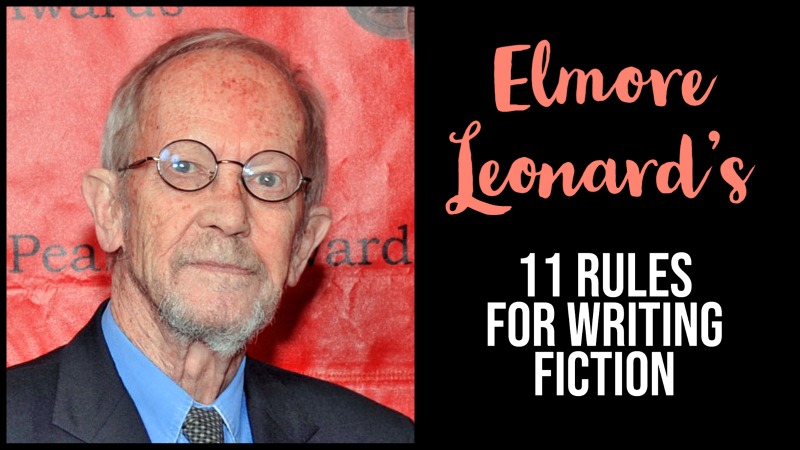
Elmore Leonard’s 11 Rules For Writing Fiction
Never open a book with weather. If it’s only to create atmosphere, and not a character’s reaction to the weather, you don’t want to go on too long. The reader is apt to leap ahead looking for people. There are exceptions. If you happen to be Barry Lopez, who has more ways than an Eskimo to describe ice and snow in his book Arctic Dreams, you can do all the weather reporting you want.
Avoid prologues: they can be annoying, especially a prologue following an introduction that comes after a foreword. But these are ordinarily found in non-fiction. A prologue in a novel is backstory, and you can drop it in anywhere you want. There is a prologue in John Steinbeck’s Sweet Thursday, but it’s OK because a character in the book makes the point of what my rules are all about. He says: ‘I like a lot of talk in a book and I don’t like to have nobody tell me what the guy that’s talking looks like. I want to figure out what he looks like from the way he talks.’
Never use a verb other than ‘said’ to carry dialogue. The line of dialogue belongs to the character; the verb is the writer sticking his nose in. But ‘said’ is far less intrusive than ‘grumbled’, ‘gasped’, ‘cautioned’, ‘lied’. I once noticed Mary McCarthy ending a line of dialogue with ‘she asseverated’ and had to stop reading and go to the dictionary.
Never use an adverb to modify the verb ‘said’ … he admonished gravely. To use an adverb this way (or almost any way) is a mortal sin. The writer is now exposing himself in earnest, using a word that distracts and can interrupt the rhythm of the exchange. I have a character in one of my books tell how she used to write historical romances ‘full of rape and adverbs’.
Keep your exclamation points under control. You are allowed no more than two or three per 100,000 words of prose. If you have the knack of playing with exclaimers the way Tom Wolfe does, you can throw them in by the handful.
Never use the words ‘suddenly’ or ‘all hell broke loose’. This rule doesn’t require an explanation. I have noticed that writers who use ‘suddenly’ tend to exercise less control in the application of exclamation points.
Use regional dialect, patois, sparingly. Once you start spelling words in dialogue phonetically and loading the page with apostrophes, you won’t be able to stop. Notice the way Annie Proulx captures the flavour of Wyoming voices in her book of short stories Close Range.
Avoid detailed descriptions of characters, which Steinbeck covered. In Ernest Hemingway’s Hills Like White Elephants, what do the ‘American and the girl with him’ look like? ‘She had taken off her hat and put it on the table.’ That’s the only reference to a physical description in the story.
Don’t go into great detail describing places and things, unless you’re Margaret Atwood and can paint scenes with language. You don’t want descriptions that bring the action, the flow of the story, to a standstill.
Try to leave out the part that readers tend to skip. Think of what you skip reading a novel: thick paragraphs of prose you can see have too many words in them.
My most important rule is one that sums up the 10: If it sounds like writing, I rewrite it.
This is the sixth post in a series on the greatest fictional world buildersand how they canteach you to write. Our sixth fictional world builder is Frank Herbert.
Frank Herbert is the most thorough world builder. He is best known for his book Dune – a work of fiction that Arthur C. Clarke would call The Lord of the Rings of Science Fiction. He was born 8 October 1920, and died 11 February 1986.
While that is quite the accolade, Duneis so much more than that. In this article we will explore this, find out what made this work so unique, and how it changed Science Fiction forever.
Frank Patrick Herbert Jr. created the most complex work of Science Fiction ever to be read by more than just an editor. Foundation is a close second, lest Asimov fans feel slighted. However, they are very different books.
The Dune Series takes place over the course of several thousand years with only one character making an appearance in all the books, or at least his clones do.
The books deal with increasingly complex ideas about humanity and what it means to be human. For example, just being born does not grant a person the right to be thought of as a human.
Throughout the first three books, Paul, the protagonist, must struggle with the idea that what he is doing is evil and he knows it.
However, since he has been blessed with future-sight, he knows that it is also the right thing to do for the human species. Even though he knows it will damn humanity to thousands of years of cruelty, war, and worse.
The Galaxies
Dune’s universe is vast. The empire covers thousands of galaxies and countless billions of star systems. However, all the action happens on the most important planet, Dune.
Dune, or Arakis, to the off-worlders, is a desert planet with the most valuable substance in the universe – Spice. All the great powers of this empire vie for control of it.
Dune is action-packed and quite violent. But, it’s not about the action. It is about philosophy and psychology. It is about the long-term goals of the human race. It is also about how to run, and how to destroy, empires.
Computers are banned on Dune due to an Artificial Intelligence uprising that probably destroyed the Earth.
Rich people have human computers that help them do all their calculations. These are specially-bred men and women, Mentats, who have the important duty of not making mistakes. They calculate trajectories of space ships, they keep the stock market running, and they make complex models of molecules. They make modern civilisation possible.
But, without the Spice none of this would be possible. The Spice lengthens a human’s life. It makes their mind fast enough to calculate inter-dimensional warp jumps though subspace. It lets them predict the future. And it allows our protagonist, Paul to see the future with perfect accuracy.
He can see the consequences of his every action. He knows how and when he will die, and everything that will happen after that.
At one point, he loses his eyes. But, because he can see every consequence of every action, there is nothing that can “trip” him up, so to speak.
Everything about Dune is fascinating. Some of it is disgusting. Some of it is horrific. But, all of it will leave you with the pleasant experience of having a new thought for the first time.
Planning the book
Dune was going to be a short article for Oregon Dunes magazine about climate change, but he ended up with too much material and missed his deadline.
At the same time, he and his wife became friends with a couple who were psychologists. They would introduce Herbert to many historical and academic thinkers that shaped the ideas in Dune.
He was able to write full-time, thanks to his wife, and expanded the research he had done into a 412-page novel.
Nevertheless, the book took six years of research and planning to complete. It was published in three parts in Analogue magazine followed by a five part sequel. These two series would go on to become Dune and Prophet of Dune.
Planning the world
Herbert did not simply plan for the plot. He built his world. I mean he really considered what made it work. Dune is famous for its giant sandworms, but Herbert wanted them to make sense. He made them the reason that the planet Dune was all desert.
He made the sand worms the cause of the planet’s ecology. The worms made the Spice that people used to extend their lives and sharpen their minds. This made the planet worth fighting over.
The worms consumed the planet’s water in their larval stages, but were poisoned by it after that. This explains the deserts. But, they also made the oxygen needed for human life as a by-product. This explains how the planet could sustain so many humans and be a desert wasteland.
The worms explain why this world was so dangerous and home to harsh nomadic tribes and not gentle pastoral peoples. They were territorial and would eat anything they could sense moving on the sands. So, people could not move about normally and they had to be careful in harvesting the Spice or even walking in the desert.
The ecology of this harsh planet made these people, the Fremen, tough and warlike. Their world was a place of death, of life on the brink of nothingness. They did not cry for the dead, because that would waste water. To avoid attracting sand worms, they learnt to control their bodies perfectly so they would not sound like walking humans on the dunes, but like sifting sand instead.
They were efficient in their movements and deliberate in all their actions, which helped them in fights. Generations of conditioning on this world had removed the slow, the lazy, and the stupid from their gene-pool. Their psychology was fully able to deal with the harsh realities of life.
Thus, when Paul needed an army to win his war, they were the perfect candidates.
There is no hand waving for Herbert. Everything was planned and, for the most part, made perfect sense. The magic-like Spice is even explained at length in later books.
2. Why He Did It
Herbert was a journalist, and later a speech writer, and he just could not help wanting to write.
After failing to complete his Creative Writing Course at University, he went back to journalism. He began reading everything in Science Fiction. After about ten years (one might say the equivalent of a good post-grad degree), he wanted to write.
He began selling short stories to magazines. He had a number of minor successes, but nothing that made any money.
Until Dune. Dune is the kind of book that is given to an author like some kind of divine blessing. Nothing like it existed before. And, for Herbert, nothing he did afterwards would achieve that level of popularity.
For the rest of his life, he would be consumed with expanding the world. Even after his death, his son published dozens of novels based on the notes he left about his world.
There was just so much to this world that it did not even rely on characters to move the story forward. If felt like the universe he made was out there doing things, and it was just so big that it could not be controlled.
Things happen in Dune because they make sense, not because the author needs them to finish the story. This is something all authors should aim for.
3. When He Did It
Herbert wrote Dune in the 1960s over the course of six years.
It was a stable time for the world and Herbert. His wife provided for the family and he wrote.
However, we can see the impact of The Cold War and the after-effects of World War II in Dune.
The world of Dune exists in a stable state of continuous war. Dune follows a period of human history where humans were almost wiped out by the machines they created. This is perhaps a reference to World War II.
And, there is a constant state of espionage and subterfuge at play in Dune. This is characteristic of The Cold War period.
However, it is more important that he wrote it after Asimov, Heinlein, and Anderson. The Foundation series by Asimov is particularly relevant and Dune can be seen as a reaction against the cold, number-driven plot of Foundation.
I don’t think he wrote the book for anyone in particular. I think he wrote against a number of cultural forces in American society.
Dune is concerned with making religion make sense. Herbert would find useful elements of Zen Buddhism, Catholicism, Islam, and others, and squash them into a scientific order of female nuns –the Bene Gesserts.
They would use the tools of religion to control the course of human evolution. This is the foundation of the plot. And the most similar element to Asimov’s Foundation
He used Islamic ideas and words to suggest the nomadic nature of the Freman, a people who had to endure a great deal of suffering. However, all religion in the Dune universe is just a front for the Bene Gesserit order. We learn that they are playing all side of every conflict.
Until they create Paul and things start to go wrong for them.
As well as critiquing religion, he was deeply concerned with the environment and how our world would be a “sand worm”-eaten desert without proper ecological management.
He creates a character for just this purpose, Liet Kynes, who has spent his long life secretly working with the Fremen to repair Dune’s ecology from those who would simply exploit it for the precious Spice.
Spice is probably a metaphor for oil in our world. Our all-consuming need for it has destroyed an entire region of Earth and is making our world uninhabitable.
The novel that launched the most thought-provoking novel in Science Fiction is a rite of passage for anyone who considers themselves well-read.
It introduced the word Ecology to the English language. It has also inspired many academics and sociologists to make it their field of expertise.
If you read Dune, you will leave with an education that is worth something.
While I love Lord of the Rings, Dune is not simply the Sci-Fi version. The most you will leave Lord of the Rings with is a healthy morality and a desire to eat like a Hobbit. Dune may actually open your mind to a wide range of thoughts. Personally, it helped me put my life into the correct perspective during a difficult time, which I am very grateful for.
Don’t base your moral code around this book unless you are a sociopath.
The David Lynch film is a famous work of art in its own right. I remember being traumatised by it in English Class. It is not anything like the book and will not give you any insights into Frank Herbert.
David Lynch who made Eraserhead and Elephant Man is better suited to body horror and surrealist film than a serious meditative work of fiction. The film lost a tremendous amount of money. Lynch was reportedly impossible to reason with, leaving neither himself, the producer, nor Herbert happy with the result.
However, as one of the most expensive work of “experimental” Sci-Fi horror ever made, it is taught for its unique style in film school.
The Syfy (that is how they “spell” it) Channel made a three-part miniseries that won two Emmys.
It is a much better adaptation. It was cutting edge with a modern feeling when it came out. Looking back, the special effects are now… cute but it gets the overall idea of Dune and is worth a watch.
Note: It does dumb the story down and you don’t get the depth of thought and complex ideas that went into the original book. I suggest reading the book and then enjoying this for what it is.
I don’t often speak about video games, but the Dune II Video Game (1992) by Westwood was notable for inventing the Real Time Strategy genre. It is considered one of the most influential games of all time.
Its combination of story, acting, and strategy have shaped the way games are created.
6. The Last Word
If Dune is the only Science Fiction book you ever read it might just be enough to keep you from embarrassing yourself at dinner parties with your nerdier friends.
It contains the best and worst thoughts on human civilisation, as well as scathing criticisms on everything you hold dear and to be true. You can only grow from reading this masterpiece.
The gold star of bestseller lists is The New York Times Best Seller list. But trying to get on the list is tricky. Firstly, there is no one defining list. The New York Times has sixteen different lists and the same 10 – 15 books can appear on all of them at the same time.
To even make the grade, you must have sold between 5 000 and 10 000 traditionally published books in one week – Sunday through Saturday – across America through multiple retailers, mostly bookshops.
Apart from the occasional romance book, self-published books don’t stand a chance.
Is it easier to sell non-fiction books? No. The market is far more competitive, and the minimum number of sales needs to be 7500.
Surely there must be more to it than that?
There is, but what that entails, as far as The New York Times is concerned, is a very closely guarded secret.
So what’s a writer to do?
It depends. Are you wanting to stay true to your own voice and write the books you want to read? Or do you want to chase the market?
If you want to chase the market and only write the types of books that are currently selling, it’s important to remember that you must research what books are selling now, write one, find a publisher and then sell your book. Just finding a publisher could take six-months to a year. Once you’ve signed on with a publisher it could take six months to a year before your book hits the bookshop shelves. By then, the Vampire Nuns genre that was selling off-the-chart numbers when you first researched ‘what books are selling now’, has given way to variations of Scotsmen In Mongolia.
I want to stay true to my own voice
Okay then.
In terms of the writing:
Read great books in your genre. Read a lot. Never stop reading.
Join writing groups – not just to chill, but to write… a lot and get feedback as this will help improve your writing.
Have book discussions with other authors and readers. This matters because it’s while debating the merits of Darcy of Pemberley vs Geralt of Rivia, that you discover what readers understand, prefer, and want, as well as when one type of hero is needed over another.
Join writers’ groups preferably in your genre. These are great not just for the comradeship but can also help if a writers’ block falls out the ceiling and hits you on the head rendering you idealess.
Join an author crit circle. One with strict ‘kindness’ rules.
Go on writing retreats, alone or with other writers who actually want to write.
Write as much as possible.
Experiment with your writing. Don’t just stick to one genre as exploring other genres, voices, tenses, and word counts, will strengthen your writing muscles. You’re not required to publish these experiments; they are writing gym. Want to write great tension in romance? Practise writing horror stories with very short word counts.
Create memorable and relatable characters/scenes/scenarios/locations/choices etc.
Write with the audience in mind. If you’re writing romance, you must have an HEA (happy ever after) or a HFN (happy for now) ending, or it won’t qualify as a romance, and readers will be miffed. It’s hard to win back a miffed reader.
Some advice blogs will tell you to edit for clarity not perfection. I’m not one of them. Edit first for clarity, and then for perfection. In this technologically driven day and age, there is no excuse for typos or incorrect grammar, unless the incorrect grammar is a plot device.
Get alpha reader feedback. Grow a thick skin and become humble and open to hearing criticism and learn what do with it.
If you are self-publishing – Unless you are a trained graphic designer DO NOT design your own cover. Knowing how to use Canva does not make you a designer. The easiest way to tell if a book’s cover was created by a non-designer, is the typography. Hire a designer, preferably one with a portfolio that includes book covers in your genre.
(Optional) Find an excellent agent.
(Optional) Find a publisher.
(Optional) Sign a book contract.
The last three are optional as you may choose to go the self-publishing route.
In terms of ‘bestselling’:
Know that the average book sells no more than five hundred copies in the author’s lifetime.
Know that if you want your book to sell more than that you’re going to have to put in the work, and often potentially a lot of money, into making that happen.
Read as many books as possible on book marketing, Amazon marketing etc., that you can.
Learn how to recognise and avoid the book launch scams.
Hire a great publicist – get recommendations from other highly successful authors. Look for a publicist that has experience in getting authors and or books known, discussed, and sold through a variety of media.
Launch the book more than once. One book launch does not a bestseller make. Research which kinds of launches are the most successful.
Do continual book promotion and marketing – but not to your friends and family. Not if you want to still be invited to pizza and Netflix evenings.
If you’re going to write a series, write the first three books and launch them all at once. This matters more than you realise.
Keep writing. Even if it’s just one short story a month.
The Last Word
If you’d like to write for children, young adults, or adults, why not sign up for one of the rich and in-depth courses that Writers Write offers to learn how to write the best book you possibly can.
by Elaine Dodge. Author of The Harcourts of Canada series and The Device Hunter, Elaine trained as a graphic designer, then worked in design, advertising, and broadcast television. She now creates content, mostly in written form, including ghost writing business books, for clients across the globe, but would much rather be drafting her books and short stories.
Do you want to try something different in your short story? In this post, we give you 6 ways to experiment in short stories.
One of the best things about a short story is that you have the opportunity to experiment. It gives you the chance to do something you have never done before.
Here is a list of suggestions if you want to try something different. You can use them for any story – not just short stories.
6 Ways To Experiment In Short Stories
Change viewpoint: If you have been writing in the same viewpoint, try a completely different one.
Dialogue only: Flex your dialogue muscles and see if you can tell a complete story with only dialogue.
Descriptions and telling: I am a huge fan of showing, but I need to practise tellingtoo. Try rewriting your story with telling only.
Unreliable narrators and anti-heroes: Try writing a character who isn’t a perfect guy or a hero. If you always write about bad guys, try writing a story about a character with a very strong moral compass.
Different genre: Pick a genre you have never written in before.
Devices: Try adding a new element to your story. Thinks of speeches, emails, letters, diary entries, songs, and recipes.
These are only a few suggestions, and it will be tricky. You may not end up with your best story, but you will have learnt something new and done something different. This is about learning after all.
Happy writing!
Top Tip: If you want to learn how to write a short story, sign up for our online course.
Dystopian fiction is an increasingly popular genre, even though it depicts all the worst places ever! We tell you all about the genre and give some hints on how to write Dystopian stories.
What Is Dystopian Fiction?
Basically, Dystopian fiction talks about an author’s idea of hell on Earth. As a genre, it’s as old as humanity. Dystopian fiction is often considered the ugly twin of Utopian fiction. So, let’s take a brief look at this.
As a genre, Utopian fiction existed first. It takes its name from Thomas More’s novel Utopia (1516). ‘Utopia’ sounds very much like the Greek ‘eutopia,’ meaning ‘good place.’ In his book, More describes an ideal society on a secluded island, where humanity can live happily ever after. As a literary genre, Utopian fiction has its own characteristics.
Now, back to the Dystopian fiction. The Greek prefix ‘dys-‘ means ‘bad, diseased, abnormal, difficult.’ That already tells you that Dystopia is the ‘bad place.’ Dystopian fiction describes a world much worse than our own. In these stories, people live in a dangerous, oppressive, and unfair place. Let’s look at some more characteristics.
1. The Mission.
This is the most important element. Dystopian stories are all geared at showing us what could happen in the future if the current society continues on its path. It’s a call to action to stop in our tracks and to change our course. If not, we’ll go to that fictional hell described by the author.
The mission can be about our society as such (like ‘The Hunger Games’, depicting totalitarianism and media manipulation), or about a smaller aspect (climate change, for example, or the outbreak of a virus).
2. Distance to the Reader’s Present
Dystopian stories need to be set apart from our present reality. This distance lets us accept the message of the story. Without it, readers would take the criticism personally and ultimately dismiss it.
The author can create this distance by time (science fiction or historical fiction), by place (inventing a new city or even another planet), or by manner.
Distance by manner can involve fantasy, but full-blown fantasy creates too much distance. The readers would no longer transfer the Dystopian warning to their own reality. This would ruin the story’s mission.
A smart way to create distance by manner is to create an alternative history starting at a specific event in the past.
The TV show ‘The Man In The High Castle’ works like this. The alternative historical timeline starts with a different outcome of the Second World War. The story explores how the world would have been under Nazi rule. This parallel universe seems uncanny because it is so similar to our own world and yet so strikingly different.
3. Setting
The author must be meticulous about worldbuilding. Even if the Dystopian story is mostly set in our own day and age, the rules and laws of that Dystopian society need to differ from our own, and yet still form a consistent system. Inconsistency makes the story lose its magic.
4. The Guide Character
Both Utopian and Dystopian stories require a character who guides the readers into the world of the story. It is through these characters that we explore the set of rules of this new world.
Utopian novels have a strong connection to our own world. Usually, there’s a character visiting the Utopian world first, and then telling the story when back home. The guide character here is usually a witness.
A Dystopian story may have that (but doesn’t have to). Usually, it’s the main character (MC) who serves as the reader’s guide. Readers need to be able to identify with the MC, as this character either experiences or witnesses the rebellion against the oppressive system.
Central Themes Of Dystopian Fiction
Most Dystopian stories have certain themes in common. Here are a few:
1. Control/oppression
There’s always a dictator or an elitist group in charge. They control society through government, bureaucracy, and/or technology. The spectrum of control can range from mere surveillance to psychological and even physical control (birth control, or mind control through implants, for example).
2. Loss of individualism to a collective ideology
This ties in with the general totalitarian feel of most dystopias. It’s the logical consequence of the complex set of rules of oppression.
3. Hostile environment
If the environment threatens the existence of the Dystopian society, then people have nowhere to escape. This is another form of control, serving as an excuse to herd people together in confined spaces.
4. A scapegoat
A scapegoat, a universal threat, or a common enemy all serve to unite the people. It camouflages the motives of the oppressive government. It makes it easier to control the people.
5. Survival
The need for survival is how the oppressive government justifies its control. However, this is also the reason for the MC’s rebellion, as the MC needs to fight for the survival of the individual.
Let’s Write Dystopian Fiction
If you’d like to try writing in this genre, here’s a word of warning. There’s no dabbling. There’s no pantsing. As a writer, you need to plot meticulously.
Here’s your action plan:
Decide what aspect of modern society aggravates you the most. This will serve as the mission of your story. Amplify and exaggerate as much as you can.
Decide on how you can employ the element of distance in your dystopia (distance by time? By place? By manner?). Build your world. Make sure it is consistent.
Devise a protagonist. How can your MC’s experiences show the rules of this new world to the reader? Beware of too much telling.
How does your MC get into conflict with your dystopian world? Is there an area where your MC doesn’t feel at home? This is where the MC’s rebellion will start.
What’s the MC’s inner motivation? What are the MC’s strengths that might help win the conflict?
Will the MC win? Or lose? What does the MC’s rebellion do to change the dystopian world?
The Last Word
Dystopian fiction is a genre popular with authors and readers alike. It doesn’t have to include outright violence, and it doesn’t have to end up in chaos. But it’s a great way to show the troubles and conflicts of our present day. What do you think could be done about it all? Have a go and write your own Dystopian fiction!
By Susanne Bennett. Susanne is a German-American writer who is a journalist by trade and a writer by heart. After years of working at German public radio and an online news portal, she has decided to accept challenges by Deadlines for Writers. Currently she is writing her first novel with them. She is known for overweight purses and carrying a novel everywhere. Follow her on Facebook.
What are the themes in children’s stories? We discuss what a theme is and what the 10 powerful recurring themes in children’s stories are.
What do children want from a story?
Children want three basic elements in a story: suspense, characters who are believable, and characters who act to solve problems. We find our themes in the problems.
Superficially speaking, children like stories that include adventure, mystery, excitement, discovery, daring, novelty, and humour.
Ad ends in 11
I want to repeat a quotation from my first post in this series on writing for children: William Nicholson had C.S Lewis say in Shadowlands: ‘We read to know we are not alone.’
Children want to know that there are ways to cope with dilemmas. Writers must offer ideas and strategies that show children they are not alone.
What are themes in children’s stories?
I have included a list of themes that deal with issues that are important to this youthful audience. They cover the anxieties, fears, and desires that children experience. There are many plots you can choose as vehicles for these stories, but all of them need the protagonist to find a way to address a problem.
What Is A Theme?
A theme can be found by answering one, or both, of these questions:
What does the protagonist learn about him or herself in the story?
What does the protagonist learn to cope with in the story?
10 Powerful Recurring Themes In Children’s Stories
Courage.
Friendship.
Belonging/Identity.
Family.
Loss/Grief.
Growing Up.
Anger.
Suffering.
Jealousy.
Love.
Examples from popular fiction:
In Charlotte’s Web, Wilbur survives because of the love and friendship of Fern and Charlotte.
The Harry Potter series includes all these themes, but the most prominent theme is finding the courage to face evil so that good can prevail. You can read more about the other themes in the books in this post.
The main themes in The Hunger Games series are: suffering in an unequal and unjust society; loss of loved ones; and courage. Katniss has to find the courage to survive physically, to fight an unjust system, and to deal with loss and grief.
In Where the Wild Things Are, Max is sent to his room without dinner for disrespecting his mother. The author deals with Max’s anger by taking him on a trip to the magical land of the wild things.
Remember that the complexity and depth of the theme changes depending on the age level for which you are writing.
TOP TIP: If you want to learn how to write for children, sign up for kids etc. online
Children want to have fun
Remember that writing with a theme in mind does not mean that you have to preach. In fact, you should avoid it. You have to show and tell in these stories and reveal the theme through the development of the protagonist.
What is contrast in writing? We explore how to use contrast in writing with 7 different types of contrast (with examples) that you can use in your writing.
What Is Contrast In Writing?
Contrast in writing can be used as a literary device to compare. It is commonly used in many works of fiction. It is ‘the state of being strikingly different from something else in juxtaposition or close association.’ (Source: Oxford Dictionary) Basically, it means comparing two things to show the differences between them.
How To Use Contrast In Writing
Back in the day, when cowboy shows were popular on afternoon television, it was easy to see who the good guys were – white hats, and who were the baddies – black hats. That kind of contrast is way too on the nose. It was then. It certainly is now. When it comes to storytelling, there a number of different ways in which you can use contrast. We’re going to look at seven of them – with examples.
1. Juxtaposition
The most famous use of juxtaposition in literature is the opening paragraph of Charles Dickens’ A Tale Of Two Cities’. Without going into any political or geographical detail, Dickens’ paragraph places the reader right into a location rife with danger, despair, upheaval, and confusion. It puts the reader on the edge of their seat right at the beginning.
“It was the best of times, it was the worst of times, it was the age of wisdom, it was the age of foolishness, it was the epoch of belief, it was the epoch of incredulity, it was the season of Light, it was the season of Darkness, it was the spring of hope, it was the winter of despair, we had everything before us, we had nothing before us, we were all gong direct to Heaven, we were all going direct the other way…”
If you use contrast in terms of phrases, try not to use clichés. Yes, I know Dickens used them in this opening paragraph, but a) he’s Dickens, and b) the way he used them here matters. You’re not Dickens. Try to use unexpected words, Instead of ‘light and dark’ find words that either mean the same thing or evoke the same meaning.
You can also have juxtaposition in the different characters in your book – kind vs cruel, rich vs poor, content vs restless.
In North and South by Elizabeth Gaskel, the contrast between the mill owners and the workers are brilliantly contrasted. We are taken into the world of both by the main protagonist, Margaret Hale. We see them through her eyes. We understand and have empathy for both because we can see both points of view. We want both ‘to win’. It keeps us glued to the book. Glueing your readers is good.
2. Cognitive Dissonance
The act of holding two different thoughts and beliefs as true at the same time. This often leads to inner conflict within the character. ‘She loved him, and yet would die a happy woman if she never saw him again, even though she knew she would long for him every day, miss him sitting across the dinner table each night. No, she hated him, and prayed that he would stay.’
This kind of turmoil will inevitably lead to actions that will drive the dramatic arc of the book’s plot. Shakespeare was a master craftsman at cognitive dissonance – think of Macbeth and his internal struggle against killing his friend vs attainting the throne.
If your character has no cognitive dissonance, he or she is at best a psychopath or at worst, a two-dimensional character.
3. Fish Out Of Water
Being a fish out of water doesn’t necessarily mean the entire person doesn’t belong, it could just mean that the hero would rather no one knew about his heroic deeds. When they are discovered, his discomfort, his fish-out-of-water-ness, is in the acclaim, news interviews, his picture in the paper, etc.
Another fish-out-of-water type would be a character in a time-travel story. Just think of Marty McFly in Back To The Future. A normal, average young man transported from 1985 back to 1955. To the people he encounters there’s something just a little off about him. Not in a bad way, more as if he were a stranger from another country whose experience and knowledge is based on hearsay.
Forest Gump, the titular character from the novel by Winston Groom, could have been on the autism scale. He could either be a ‘fish out of water’ or an ‘odd person out’.
4. Odd Person Out
Legally Blonde is a perfect example of an odd person out. By the end of the film, she may still not be the archetypical lawyer from Harvard, but she has earned her place and stayed true to herself. The odd person out can be a breath of fresh air.
Another ‘odd person out’ is Mr Darcy. While the world around him has more easy manners and interactions, and is prepared to be pleased, Darcy’s upbringing, his family’s expectations of him, his wealth, pride, and shyness, tend to put him on the outside of any circle in which he finds himself. This includes the circles in which he is used to move – mainly because he’s bored to tears of them all. The trouble is, he doesn’t really know how to act in the new circles of Longbourn and Meryton in Pride And Prejudice by Jane Austen.
5. Internal Dichotomies
Inspector Javert, in Les Misérables by Victor Hugo, is a policeman whose passion for the law and justice is turned on its head when Jean Valjean, whom he has hunted for years, shows him mercy instead of killing him. Both are true at the same time – law and mercy. His internal dichotomy is so powerful that he can’t reconcile them and ends his life, Think of Hamlet’s need to keep Ophelia safe from the probable bloodshed in the near future vs his having to resort to breaking her heart to force her to leave. His internal struggle with this makes everyone think him mad.
Internal dichotomies, the internal arguments a character has make them interesting and more human, even if it’s just, ‘I really want chocolate cake, but I’m on diet, but I really want chocolate cake, but the wedding dress is already tight!’
6. Opposites Attract
This is an oft-used trope in novels, especially romance. It really only works in fiction. After all, she wants to go to her family in the country every weekend and he plays tennis at league level at the sports club down the road from their London home. He wants to go clubbing every night and she’s an introvert who is noise sensitive. Somethings got to give, and it’s usually the relationship.
7. Contrasting Descriptions
Citiesare replete with juxtaposition – civic buildings vs the dirty alleys. They not only juxtapositions in their looks but even more in their intent and population. In one there is great privilege, wealth, corruption, greed, and racism – a dank alley of human emotions and actions. While in the other there is generosity of spirit, an inclusivity, a kindness, a strength in the despair, a community among the outcast – an invisible palace of goodness. Nothing is as black and white as that; I use these merely as examples.
Another source is the weather. A wonderful event is taking place in your book, a wedding for example, but raging around the church is a violent thunderstorm. A ship could be caught in the doldrums. The sea is as still and silent as a sheet on an unused bed. But the men on board are slowly going insane from boredom, the heat and the lack of water, despite seeing nothing but water stretching out to the horizon.
What makes contrast in writing exciting and fun is creating something marvellous in words that didn’t exist before.
The Last Word
If you’d like to write for children, young adults, or adults, why not sign up for one of the rich and in-depth courses that Writers Write offers to learn how to write the best book you possibly can.
by Elaine Dodge. Author of The Harcourts of Canada series and The Device Hunter, Elaine trained as a graphic designer, then worked in design, advertising, and broadcast television. She now creates content, mostly in written form, including ghost writing business books, for clients across the globe, but would much rather be drafting her books and short stories.








 Wordsmith At Large