
By Richard Young
This is the eighth in an ongoing series in which The Beat Magazine 2025 takes readers “Behind The Scenes” to meet the talented creative individuals who make the London area such a vibrant arts and culture community.
In this segment, Richard Young conducts a Q&A Interview with London author Trina Brooks.
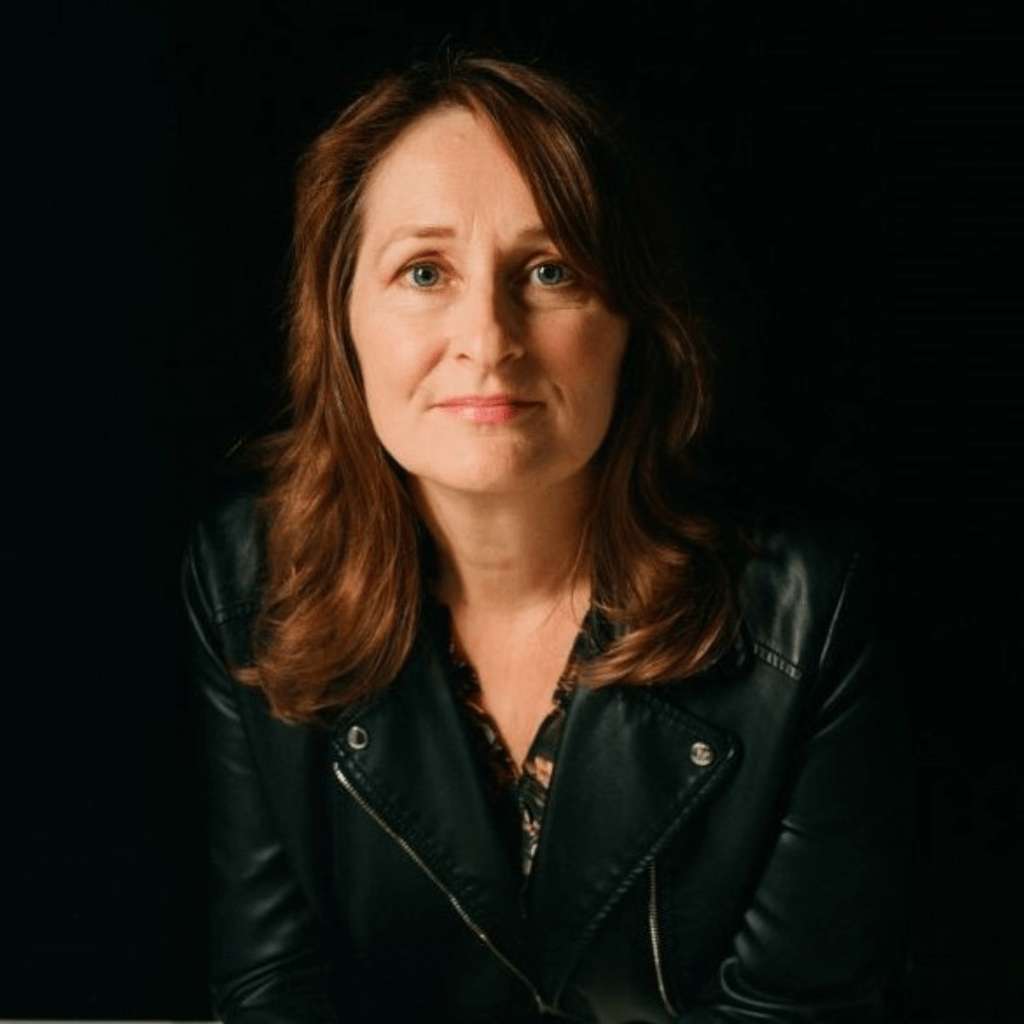
Q. Could you provide me with some basic biographical information – Where were you born? Where did you go to school? Have you always resided in London?
I was born in London and grew up, running wild and unsupervised during the time period our city has been dubbed ‘the serial killer capital’ of the world. We weren’t aware of it at the time, and as a kid my focus was elsewhere, like exploring the library, at the movies, or roaming my neighbourhood in Berkshire. In grade eleven, I switched schools specifically so I could immerse myself in theatre under the training of Art Fidler, one of the best theatre arts teachers in Canada. Between theatre and English class, it was clear my passion and abilities were creative ones. I combined both those skills by graduating from Fanshawe College in Broadcast Journalism. This is where I learned how to conduct research and constantly ask “why” about a topic, but the theatre kept calling. I moved to Toronto and jumped into the theatre scene, where I performed in everything from Shakespeare in the Park to large-cast musicals. A few years later, I travelled to London, UK, for drama school and adventure, returning a year later to this London, where I’ve been ever since.
Q. What motivated you to become a Writer?
Books and movies motivated me to tell stories that made you feel something. Growing up, I read voraciously. If I didn’t have a book, I’d scour my parents’ shelves, reading anything I could, including ‘Flowers in the Attic’ and ‘Joe Girard: How to Sell Anything to Anybody’. Besides books, much of my summer holidays were spent in dark theatres, losing myself in films of every genre. For me it’s the combination of stories that take you someplace outside your own life and learning something new. Every good story does that. I did learn things about sharks from the movie Jaws, and I could name Civil War battles from what people called my trashy historical romance books. Storytelling both entertains us and teaches us. So, like a person who goes to school for medicine because they witnessed how a doctor can save lives, I wanted to write because I knew how my life was enriched, comforted, spooked, entertained, and grew from the stories I read.
Q. Do you consider yourself a full-time Writer, part-time Writer or casual Writer?
I consider myself a full-time writer. It is what consumes most of my time and definitely the majority of my thoughts. Although I always wish I could squeeze out a few more hours at my desk working on projects, apparently I am expected to also ‘live life’ and interact with the outside world.
Q. On your Facebook page, you describe yourself as “A history, mystery writer and playwright of stories set throughout the 20th century.” Could you elaborate on that description?
After my time in England, I found myself not as enamoured with acting on the stage and speaking other people’s words. When I returned home, I began writing my own plays, telling the stories and creating the characters I wanted to see. As I wrote, without consciously planning it, the majority of my plays were historically based in the 20th century. The play I’m most known for is called ‘Left Behind ’, about a WW2 Spitfire Pilot and a veteran from the War in Afghanistan. It was the first play ever put on at the Wolseley Barracks military base. I’ve since realized I am infatuated with history from the 1900s. My theory is that it’s because I have conscious memory of events and life from the mid-70s on, but I also feel very close to the preceding decades. It’s as if I am just an echo away from the major events of the 20th century. Growing up, the WW2 veterans were people in their fifties: our neighbours, my dad’s boss, etc. My own grandmother was born in the late 1890s, so I was surrounded by people who gave me first-person accounts of the Roaring 20s, the Great Depression, and both world wars. I feel connected to our recent history, and it is such rich content, especially for someone who writes mystery novels.
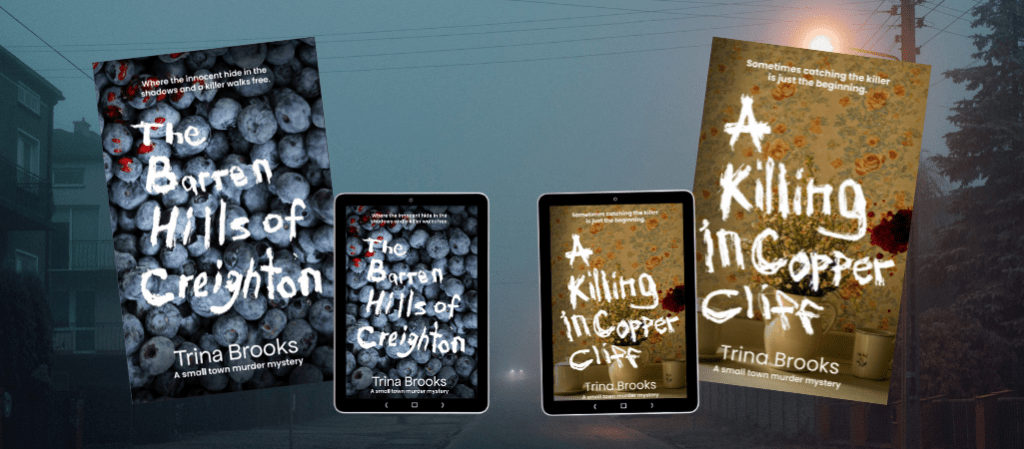
Q. What are some of the titles of the books you have published to date? What’s your most recent publication? Can you tell our readers a little bit about it?
The novels I’ve written are a crime series following the investigations of Detective Inspector Victor Lapointe. He’s a 1950s-era O.P.P officer, whose jurisdiction covers three hundred thousand square miles of the small towns and sparsely inhabited wilds of Northern Ontario. The first book, The Barren Hills of Creighton, is set in a company town. In those days, mining towns were owned and operated by the company, and you could only live there if you worked for them. I set the first book in an isolated mining town where everyone knows everyone and their business. So, when a murder takes place, it means one of their neighbours is a killer. Besides the Inspector, the character Rose has really captured the heart of many readers who keep asking for more of her story.
The second book, A Killing in Copper Cliff, has Lapointe in a different small town investigating a murder at the Teacher’s Residence with an unexpected victim and a witness with no memory. These are traditional whodunits where you are guessing until the final reveal who the killer could be. I write in a cinematic, fast-paced style, which is why many readers describe my stories as page-turners, and I like to add subtle elements and hints that keep you guessing.
Q. Do you have a publisher or are your books self-published?
I decided with my first book to self-publish, as the timelines in traditional publishing can be one to two years from acceptance to book in hand. Fortunately, it turned out I really love self-publishing, developing relationships with editors of my choosing, working collaboratively with cover artists, and having the final say on all aspects of taking the book from idea to print. With that experience, I decided to continue publishing under my own imprint, The Scribbler Press.
Q. Every writer has a unique daily routine or creative process. Could you describe a typical writing day for Trina Brooks?
I wish I could say I’m up at 4 am, write for six hours, then run 10K like Haruki Murakami or that I keep a hotel room so I can have solitary, undisturbed writing time, like Maya Angelou, but alas mine is far less noteworthy.
I usually begin with the business side: emails, finances, or working on my true crime newsletter, The Scribbler. The creative side of novel writing looks different every day. Sometimes I write furiously, tapping away as if I can’t get the words out fast enough. Other days it’s me going for a run or a walk, as that is how I work out character or plot problems. I do love to play instrumental music when I write. YouTube is a great resource because you can search out “epic instrumental”, “sad music” or “music for writing mystery”. They have pieces for whatever mood I am writing at that moment, and it helps to settle me into the scene.
Q. Are you working on anything new at the moment? Details?
Right now, I am in the middle of the chaotic first draft of the third and final book in the Inspector Lapointe series. This one will be set on Manitoulin Island. All I can say is it will have a bit of a locked-room mystery vibe as the murder takes place on a small island. I am so looking forward to my research trips because, come on, who doesn’t want to spend their summer holiday/work time on Manitoulin Island?
Q. What advice would you give to aspiring writers?
Number one, I would say dismiss other people’s ideas of what success as a writer looks like. The number of times, well-meaning people have said “Maybe you’ll be the next J.K. Rowling” when I tell them I’m a novelist, well, it’s a long list. Her career trajectory is not one you can plan or strategize for, and if you try, you’ll fail because you’re focusing on the wrong things. You have to alone decide what success is for you.
My second piece of advice is to claim your space. If you are writing regularly, working on your craft, reading books on writing, taking courses, submitting your pieces, and are actively pursuing getting your writing out to the world, then you are a writer. Not someone “who wants to be a writer”. Own it and proclaim it. It’s amazing how quickly you will fall into the role once you say it out loud. One of my greatest memories is the first time a friend introduced me as “This is my friend Trina, she’s a writer.” It was life-changing because from that moment on I was like, “Well, if people are going to know me as a writer, I guess I better start acting like one.”
Q. Is there anything else you think our readers should know about Trina Brooks the author and Trina Brooks the person?
Many people are not aware that only 13% of books purchased in Canada are by Canadian authors. I think we can do better, and it is something I’m intensely focused on. This is a vast country with so many talented writers telling our stories, set in familiar places that are often overshadowed by the best-seller market that highlights international authors. The people in Northern Ontario have devoured my books because they tell me how much they love reading a murder mystery novel and come across a building, a street, or a town they know well. How fun is that?
I strongly support and highlight Canadian authors in my monthly newsletter, The Scribbler, where I share Canadian true crime stories that will surprise you, and I also have a Reading Canada section. Each month I share a different Canadian author who you may or may not have heard of.
If you love true crime and Canadian content, you can sign up for my newsletter at my website Home – Trina Brooks
You can also follow Trina on Facebook (2) Facebook and Instagram Instagram
Interview Conducted by Richard Young, Publisher & Content Manager of The Beat Magazine 2025.

 Wordsmith At Large