
Reviewed by Jo-Anne Bishop
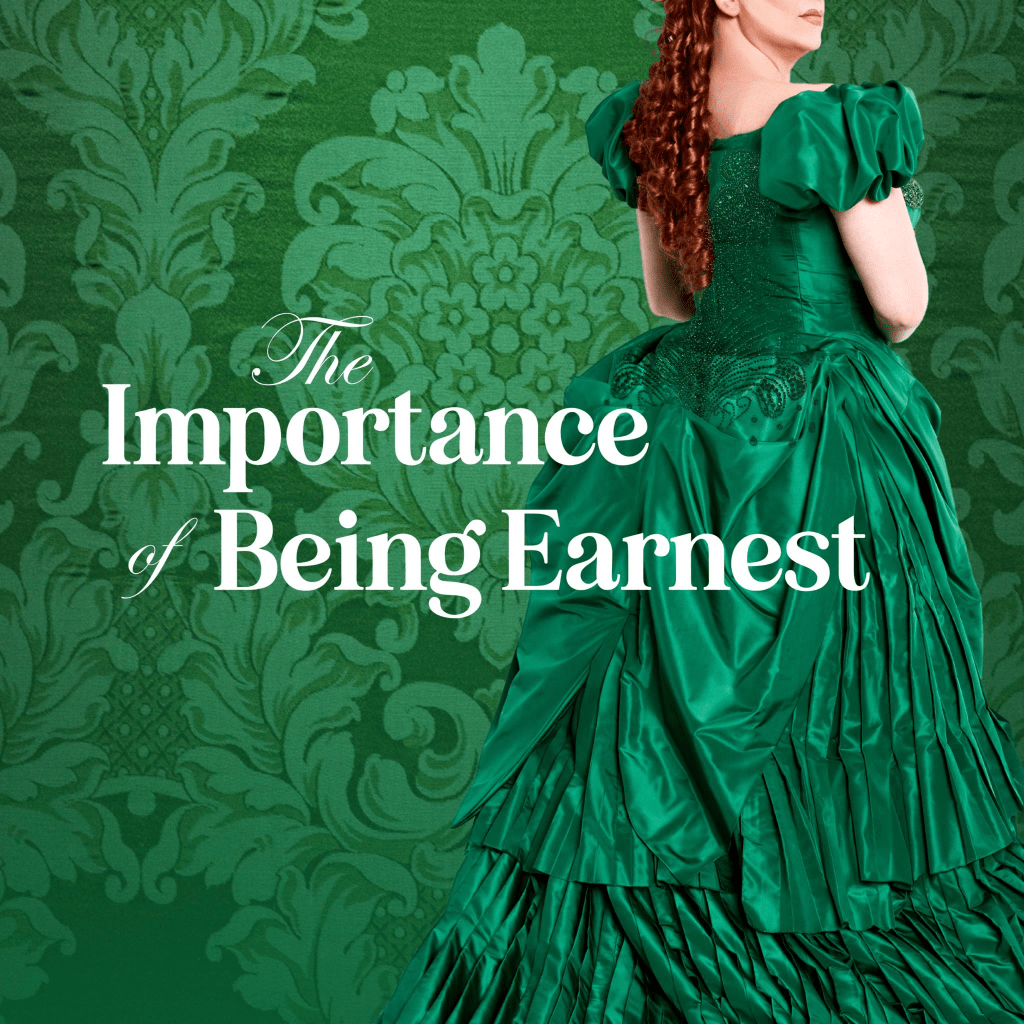
There’s a reason Oscar Wilde’s The Importance of Being Earnest has endured for well over a century. Premiering on Valentine’s Day in 1895 at London’s St. James Theatre, the play is a razor-sharp satire of Victorian society, skewering everything from marriage and class to the absurdity of social expectations. Wilde’s signature style—fast-paced, highly stylized, and dripping with irony—remains both its greatest strength and, at times, its greatest challenge.
As quoted in the director’s note, “rarely has the stiletto of dissident humour been driven so smilingly between the ribs of bourgeois convention.” This line from Neil Bartlett perfectly captures Wilde’s enduring bite.
Now playing at the Grand Theatre, this production, directed by Alistair Newton, leans boldly into theatricality, delivering a visually striking and energetically performed interpretation that feels surprisingly modern and relevant in 2026. Wilde’s themes of performative identity, social façades, and the tension between authenticity and expectation still resonate today, perhaps even more in an age of social masking, highly curated personas and digital selves.
That said, this is not a production you can passively absorb.
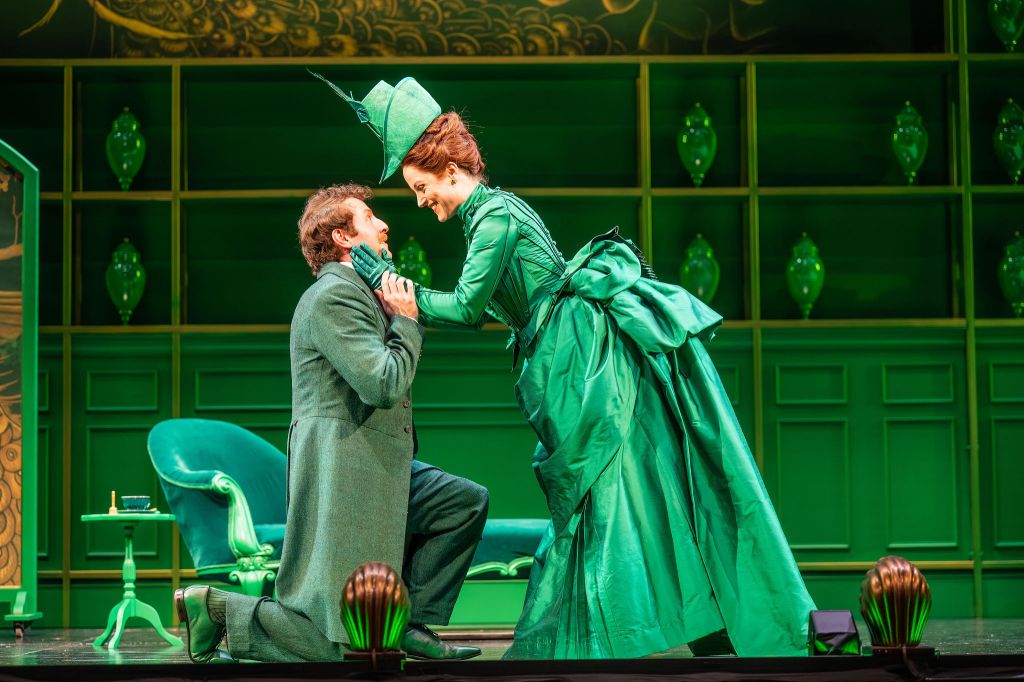
(Photo by Dahlia Katz.)
I found myself needing time to sit with the show afterwards. The rapid-fire dialogue and heightened language, true to Wilde, can be difficult to follow, especially if you’re not already familiar with the story. There were moments where I lost the thread entirely, only to piece things together in retrospect. For audiences new to the play, a bit of homework beforehand will go a long way. If you have a short attention span or struggle with dense, fast-paced English dialogue, this is one where preparation really matters.
Visually, the production makes a striking and very bold statement. Set designer Michelle Tracey creates three distinct worlds across the acts: a lush, all-green opening (down to the piano and cigarette case), a fully yellow second act, and a vivid red-and-yellow third. The only figure fully in red is the formidable Aunt, commanding attention in a room that mirrors her dominance. It’s an ambitious and cohesive design, though at times, its intensity borders on overwhelming.
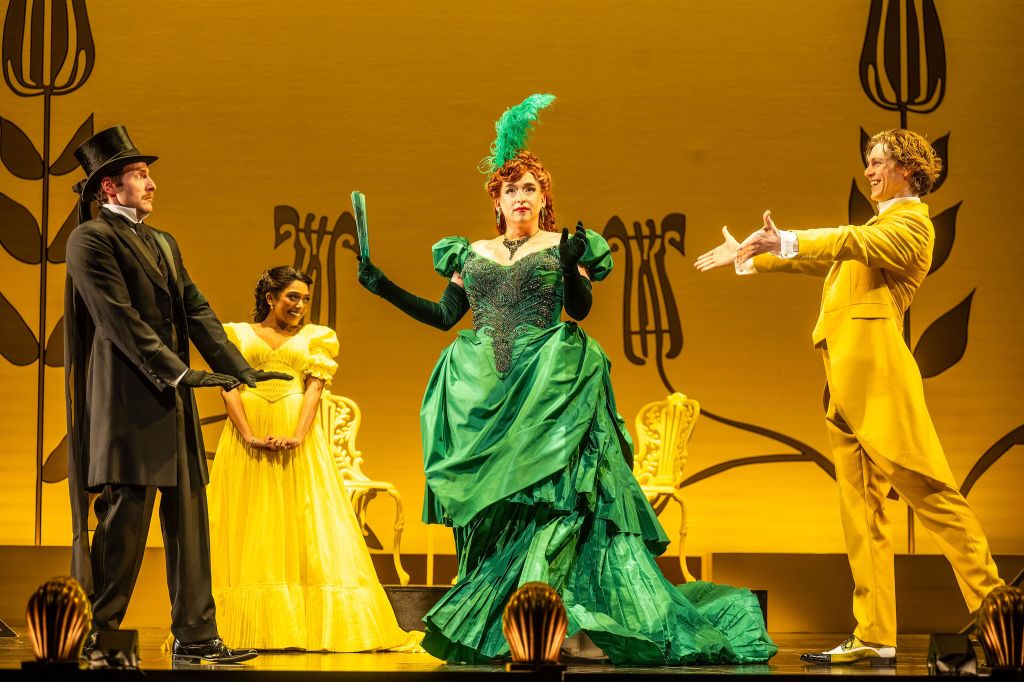
(Photo by Dahlia Katz.)
The costumes, designed by Judith Bowden, are pitch-perfect: bright, bold, and beautifully in sync with the set’s colour story. One exception is Cecily, whose costume felt slightly muted by comparison, causing her to fade visually in moments where she might otherwise shine. At the same time, it perfectly separated her character from the others, showing the contrast between the city’s pomp and the country’s quiet reserve.
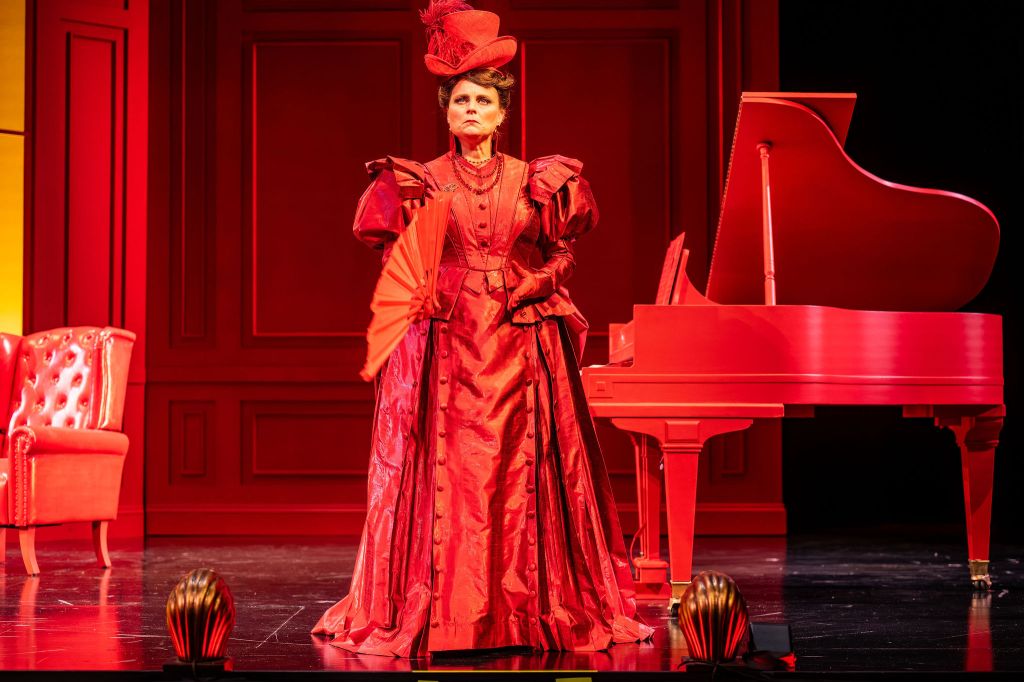
(Photo by Dahlia Katz.)
The dialect work, coached by Phyllis Cohen, is strong throughout, helping anchor the heightened language in both clarity and rhythm.
Performance-wise, the cast is superb across the board. Deena Aziz brings warmth and precision to Miss Prism, while James Daly’s Algernon Moncrieff is delightfully playful. Julien Galipeau grounds John Worthing with charm, and Kaylee Harwood delivers a sharp, engaging Gwendolen Fairfax. As Lady Bracknell, Claire Jullien commands the stage with authority and wit, while Ben Sanders capably fills multiple roles, including Reverend Canon Chasuble and Lane.
Standout performances for me came from Billy Lake as Lady Stella Clinton and the Merriman—whose drag performance drew some of the biggest laughs of the evening—and Mirabella Sundar Singh as Cecily Cardew, who brought a delightful presence and nuance to the role.
Ultimately, The Importance of Being Earnest isn’t going to be for everyone, and this production doesn’t try to soften its edges. It’s fast, it’s dense, and it demands your attention. But if you’re willing to meet it on its level, it offers a rewarding, visually dazzling, and often very funny experience. And while there may not be a distinct message or lesson to learn, it makes a bold statement.
Overall, this is a vibrant, well-directed production with exceptional performances, inventive design, and a distinctly modern pulse. Just be prepared to keep up.
IF YOU GO:
What: Oscar Wilde’s The Importance of Being Earnest, Directed by Alistair Newton
Where: The Grand Theatre, 471 Richmond St, London, Ontario
When: March 24th to April 12th, 2026.
Tickets: $25-97, available at the Box Office or online at The Importance of Being Earnest | The Grand Theatre
Reviewed by Jo-Anne Bishop

Background and Experience in the Arts
My background in the Arts started with an early love for music and dance. I attended my first concert at 10 years old (Helix at the Sarnia Arena in 1983!) and began tap and modern jazz dance lessons around the same time. My love for live theatre was built through school trips to the Stratford Festival to see plays like Romeo and Juliet, The Merchant of Venice, and Macbeth, and a trip to Toronto for The Phantom of the Opera, which quickly became my all-time favourite.
I dreamed of performing for many years, but being too self-conscious to audition in high school, I sat on the sidelines and instead reviewed music and theatre for our school newspaper. In 2013, I finally pushed my fears aside and was cast in my first play, Laughter on the 23rd Floor, as Carol Wyman, the only female writer on the Max Prince show. I have since performed in productions of Birth (Jillian, 2016), Hamish (Annette, 2023) and The Curious Incident of the Dog in the Nighttime (Mrs. Alexander, 2024).
Previous Reviewing Activities
SCITS, Sarnia, Ontario – High school newspaper reviewer for Music and the Arts
London Fringe Festival, London, Ontario, 2012-2015
Independent Reviewer and Blogger (Theatre in London and The Pollyanna Papers), 2015-2016?
Why am I jumping back into the fray now?
After performing for a few years, I’ve decided to take a break from the grind of auditioning, rehearsing and performing. While I love it immensely, it’s a lot of work. Performing has given me a whole new perspective and appreciation of what goes into a production and the ability to look at reviewing with a fresh set of eyes.
Thoughts about the London arts and culture scene, especially local theatre
Hoo wee! London has such a wealth of talent, from youth to adults. Every time I see a play, I am amazed at how talented our actors, directors, producers, set/prop/costume/light/, and sound designers are. I don’t think causal observers realize just how much goes into making a production from the audition to the curtain call. It is a huge undertaking, and to think our theatres produce such world-class productions on some very tight budgets is astounding, especially at the community theatre level, where volunteers do everything.
Sadly, since COVID, I have witnessed a huge decline in attendance at performances, and it breaks my heart. I have also noticed a sad lack of reviews lately, which I find are necessary to give people an idea of what to expect and a reason to go to the theatre.
So, before I can put my feet on the stage again, I want to help put bodies in the seats. We need to reignite a love for theatre and the arts in this city.


 Wordsmith At Large